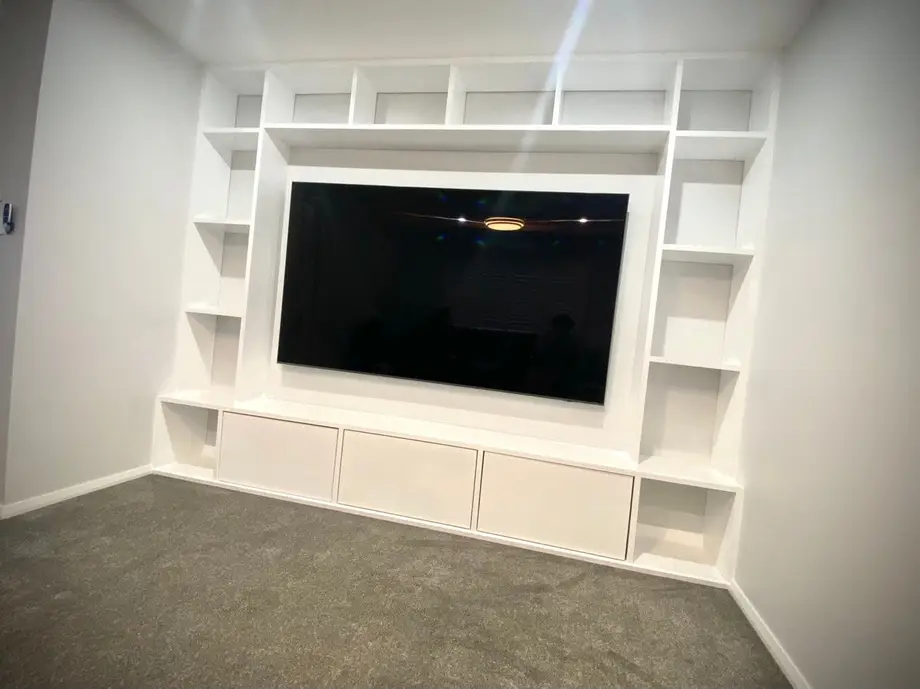
Built for rooms that were never square
Lower North Shore homes are joinery's favourite challenge: federation walls that lean a considered few degrees, alcoves beside chimney breasts, ceilings at heights no flat-pack catalogue anticipates, picture rails that deserve respect. Custom joinery earns its keep exactly here — pieces scribed to the wall they live on, proportioned to the room, and matched to details the house already owns.
The everyday portfolio: wardrobes that use the full height instead of donating the top 40cm to dust, entertainment units that swallow the cable chaos, bookcases and home-office walls, window seats with storage in the bay, under-stair solutions, and bathroom and laundry cabinetry built for moisture rather than merely priced for it.
How a piece comes to be
Measure at your place, talk through how the space actually gets used, then drawings and a fixed written price — you see the piece on paper before anything is cut. Fabrication runs in the workshop while your room keeps being a room; fitting is days, tidy, and finished properly: doors aligned, soft-close set, holes for the wire you'll add later drilled now.
Joinery inside renovations
Much of my cabinet work rides inside bigger jobs — kitchenswhere cabinetry is half the budget and most of the daily experience, bathroom vanities built for real plumbing, and robes fitted as part of bedroom refits. One maker across the project keeps the details speaking the same language, which is the quiet thing you notice in a finished house without knowing why.
Common questions
What's the difference between a cabinet maker and buying flat-pack?
Flat-pack fills a standard box in a standard room. A cabinet maker builds to your walls — out-of-square century-old walls included — uses your millimetres (floor to ceiling, skirting scribed, no filler panels), and chooses materials by the job. The price gap is smaller than expected; the fit gap isn't.
Are you a cabinet maker or a carpenter?
Both, in one crew — the workshop side builds the cabinetry, the site side scribes and fits it. That's why built-ins, wardrobes and shelving arrive made to fit the room rather than adjusted on the day to survive it.
How much does custom joinery cost?
It depends on the piece: overall size, carcass and front materials, door and drawer count, hardware level and the internal fit-out. I measure at your place, draw the piece, and quote it fixed in writing from drawings you approve before anything is cut — so the number you agree to is the number you pay.
What materials do you build with?
Moisture-resistant board and plywood carcasses as standard, doors and fronts in two-pac, timber veneer or solid hardwood by the design, hardware from the brands that still work in fifteen years. Materials are named in the quote — 'custom' should never mean 'mystery'.
How long does a joinery job take?
Measure and design first, then typically 3–5 weeks to fabrication and a fit-out measured in days, not weeks. Renovation-linked joinery is scheduled around the trades so painters follow me, not the reverse.
Do you do kitchen cabinetry?
Yes — through my kitchen renovations, where cabinetry is the backbone of the job, and as standalone runs (island benches, pantry walls, appliance garages) when the rest of the kitchen is staying.